Workforce Management – Where to Start
Where do you start when building the business case for Workforce Management? Often, the first challenge is simply understanding the workforce you already have. A practical place to start is…

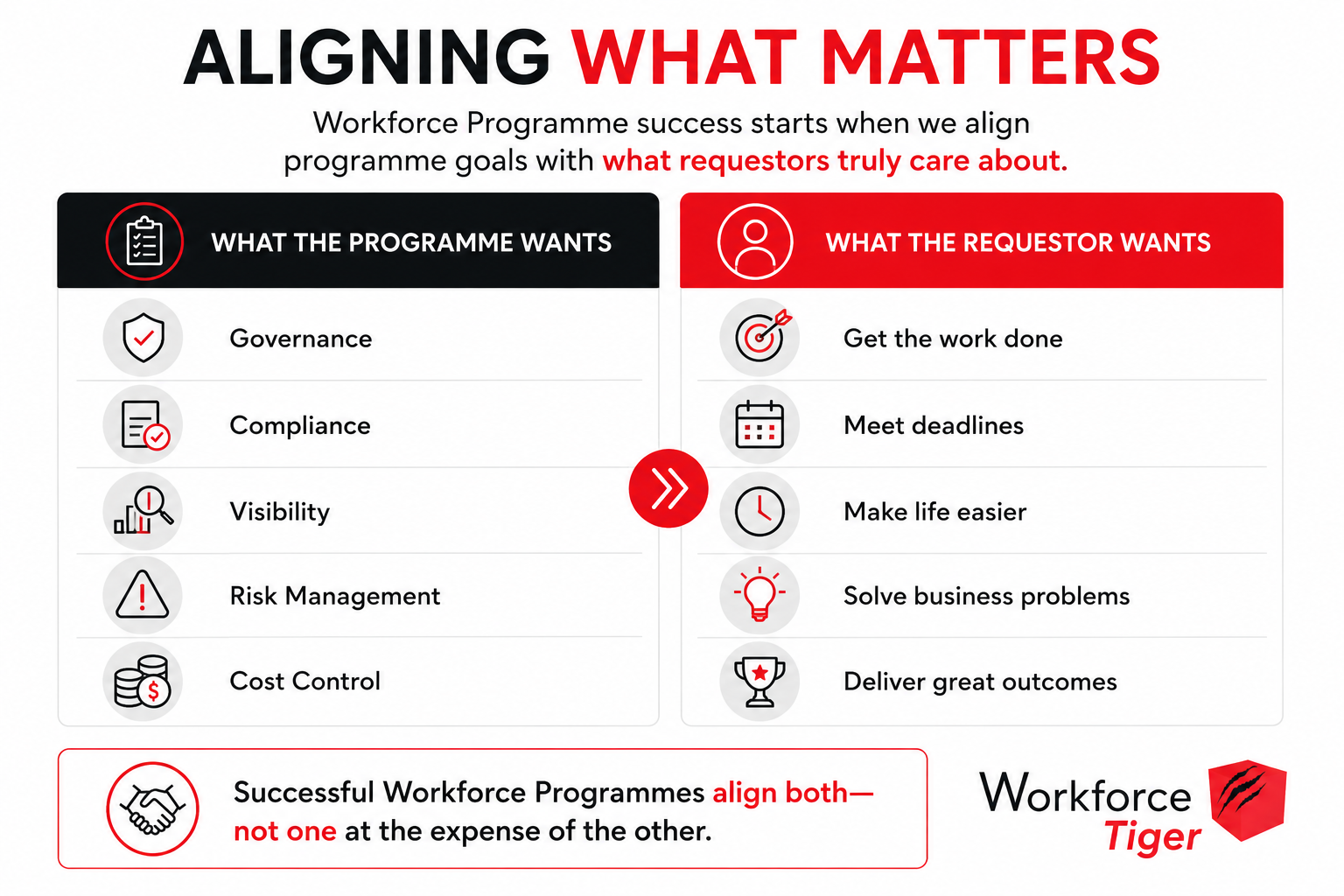
Most Workforce Management Programmes are launched with the right intentions.
All worthwhile outcomes.
The challenge is that these aren’t the reasons your business requestors come to work every day.
For someone leading a project, managing a team or delivering against customer commitments, success looks very different.
They care about:
Many have also been engaging external workers for years. They’ve built trusted supplier relationships, developed their own ways of working and know how to navigate the organisation to get things done.
From their perspective, a new Workforce Programme can easily feel like more forms, more approvals and more barriers.
That’s why adoption isn’t a technology challenge.
It’s a transformation challenge.
Senior leaders need to clearly explain why the programme exists.
Not because Procurement wants more control.
Not because HR wants more data.
But because a well-designed Workforce Programme should make it easier for the business to access the right talent, reduce unnecessary administration and create a better experience for everyone involved.
The message should always be:
“This programme exists to help you get work done more effectively.”
Every additional click, approval or manual activity increases the temptation to work around the process.
If the programme becomes the easiest way to engage external workers, adoption becomes far more natural.
Policies shouldn’t create confusion or encourage unintended behaviours.
One of the most effective approaches I’ve seen is separating external workforce governance from internal headcount reporting.
When organisations focus on understanding where money is being spent, rather than trying to fit every engagement into a headcount category, it reduces unnecessary complexity and helps prevent work being misclassified simply to avoid the process.
Simple policies are followed.
Complex policies are often worked around.
No Workforce Programme is perfect on day one.
The organisations that achieve long-term success are those that continually gather feedback from the people using the process every day.
Continuous improvement creates trust.
Trust drives adoption.
People need to see that the programme is making a difference.
Visible success builds confidence, encourages wider adoption and creates positive momentum across the organisation.
It’s easy to think your customers are Procurement, HR or Finance.
In reality, they’re the people trying to deliver work.
If your Workforce Programme helps them achieve their objectives faster, with less effort and greater confidence, adoption follows naturally.
When programmes are designed around making work easier—not simply adding governance—they stop feeling like a compliance exercise and start becoming a genuine business enabler.
The best Workforce Management Programmes don’t succeed because they’re mandatory.
They succeed because business requestors choose to use them.
When governance, technology and policy are designed to make work simpler rather than more complicated, adoption stops being something you have to enforce.
It becomes something people actively support.