Workforce Management – Where to Start
Where do you start when building the business case for Workforce Management? Often, the first challenge is simply understanding the workforce you already have. A practical place to start is…

Most organisations believe they are in control of their workforce.
They have governance. They have procurement processes. They have approval workflows.
But in reality, most of them are only controlling one thing:
How work is bought.
Not how it is defined, and that’s where the real problem starts.
Across organisations, the same moment plays out every day:
“I’ve got budget… now I need to get the work done.”
What happens next is rarely structured. A manager, often under pressure, makes a decision:
These decisions are fast, familiar, and often completely unchallenged.
But they can also be inconsistent, invisible, and in many cases disconnected from any broader workforce strategy.
By the time procurement or HR gets involved, the most important decision has already been made.
Organisations have invested heavily in managing spend. But very few have invested in managing work design.
There is no structured layer that asks:
Instead, they jump straight from requesting Budget to Execution, skipping the critical step of what is the best work engagement model.
Many organisations try to solve this with better intake.
But this doesn’t fix the problem. It just processes poor decisions faster.
What’s needed is something fundamentally different:
A Guided Work Design Layer
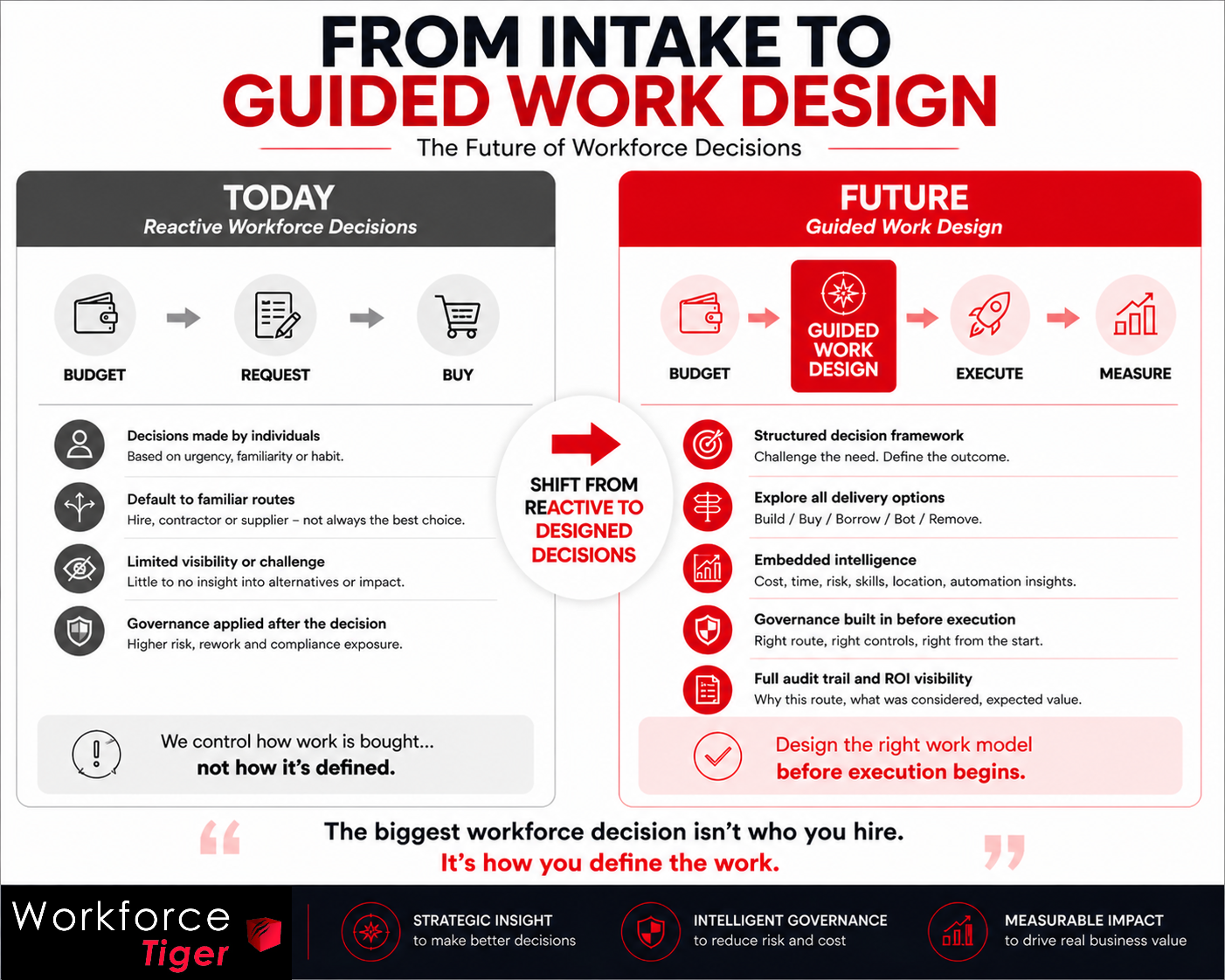
A capability that sits between budget and execution, and reshapes the decision before it’s locked in.
At its core, Guided Work Design challenges and improves how work is defined before money is spent.
1. Interprets the Real Need by asking better questions:
Because not all demand should become work.
2. Evaluates the Right Delivery Model, Instead of defaulting to an individuals bias, it systematically explores options:
This reframes the decision from “who do we hire?” to, What is the best way to get this work done?
3. Provides Decision Intelligence
Rather than relying on instinct, Guided Work Design brings in:
Now the decision is informed and not assumed.
4. Embeds Governance Before Spend
Instead of retrofitting compliance after the fact, governance is built into the decision itself:
5. Creates a Clear Audit Trail
Every decision becomes visible and explainable:
For the first time, organisations can answer a simple but critical question:Why did we decide to do it this way?
When organisations introduce Guided Work Design, the impact is immediate:
But more importantly it shifts workforce strategy from reactive to intentional.
This isn’t just about improving intake. It’s about building a Work Decision Engine. One that connects:
and the over time, this creates a closed loop:
Demand → Design → Deliver → Measure → Learn
Where every workforce decision gets smarter.
Most organisations don’t have a workforce strategy problem. They have a work design problem.
And until they fix that, no amount of tools, processes, or governance will deliver the outcomes they expect.