Over the past decade, skills-based hiring has been positioned as a major step forward in how organisations think about talent. And to be fair, it was.
It helped move us beyond rigid job titles, challenged outdated career paths, and recognised that capability doesn’t always come neatly packaged in a traditional role. It supported mobility, reskilling, and more inclusive access to opportunity.
But there’s a quiet, persistent problem many organisations still struggle with:
The job we hire for often isn’t the job that actually gets done.
The Job Description Problem We All Recognise
We’ve all seen it, and many have lived it. A role is advertised with a polished job description and a long list of required skills. A candidate is hired based on those skills. And within weeks or months, reality sets in.
The work turns out to be:
More operational than strategic
Heavier on coordination than expertise
Full of manual or administrative tasks that were never mentioned
Or missing the very activities the role was hired to perform
The issue usually isn’t the person. And it isn’t a lack of skill. It’s that the job description was never an accurate reflection of the work.
This Isn’t New Thinking. It’s a Long-Standing Reality
It’s important to say this clearly. This problem has been recognised for a long time.
I’m certainly not the first person to think this way, and I won’t be the last. One person I always enjoy listening to speaking on the topic is Bruce Morton. The focus wasn’t to highlight a dramatic workforce disruption. It was something far more practical and far more foundational.
Understanding tasks, how work actually gets done and the real components that sit beneath roles and skills.
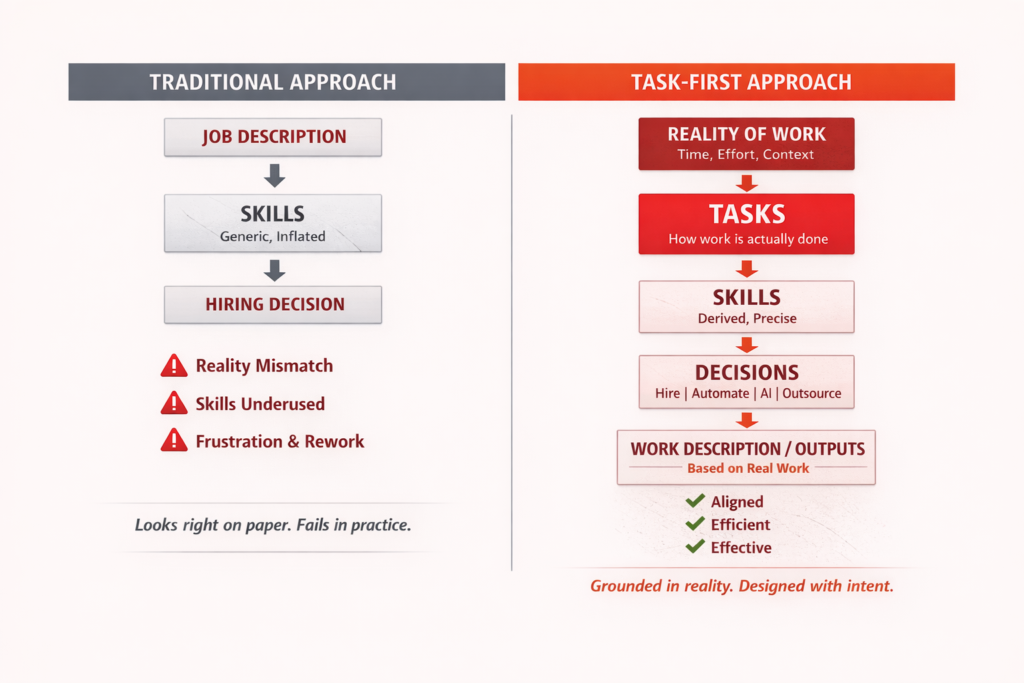
From there and only from there, an organisations can make informed decisions. Those decisions might lead to automation, AI, outsourcing, role redesign, or a blended approach. But tasks are the starting point, not the outcome.
The thinking has been around for years. The rhetoric has existed from the start. What’s been missing isn’t awareness or intent. It’s been a practical way to operationalise it at scale.
Where Skills-Based Hiring Quietly Falls Short
Skills-based hiring assumes something critical. That we already understand the work well enough to define the right skills. But if the underlying job description is flawed, even a skills-based approach is built on shaky foundations.
Skills describe capability, but they don’t explain:
Which tasks actually make up the role
How much time each task consumes
Which tasks create value vs simply keep things moving
Which tasks require judgement, and which are routine
Where work has evolved, but role definitions haven’t
The result is often this: Organisations sometimes hire capable people into poorly understood jobs.
Work Doesn’t Happen at a Job or Skill Level… It Happens at a Task Level
This is the missing starting point. Tasks are the fundamentals of work. They are observable, measurable, and grounded in reality.
When organisations break work down into tasks, they can finally see:
What the role actually involves day to day
Where effort and cost are really being spent
How work has drifted over time
Which skills are genuinely required and which are assumed
Only once tasks are understood do skills become meaningful.
Tasks First. Skills Second. Decisions Third.
When organisations start with tasks:
Role and work design become grounded in reality
Skills requirements become more precise
Hiring expectations align with lived experience
Onboarding improves
Performance conversations become clearer
Decisions about automation, AI, or outsourcing become deliberate — not reactive
Instead of asking “What skills should this role have?” They can ask “What work actually needs to be done – and how should it be done?”
So what could this look like it reality:
Decisions First, Then Accurate Work Descriptions
This shift also changes where job descriptions belong in the process. Rather than being the starting assumption, they become an output.
When tasks and skills are understood and decisions are made, organisations can create:
Accurate role definitions
Clear work descriptions and outputs
Human roles where judgement matters
Non-human or automated solutions where they don’t
In other words, work descriptions that reflect reality — and don’t always assume the answer is a person.
Skills Still Matter, But Tasks Anchor the Truth
This isn’t an argument against skills-based hiring. Skills matter. They always will.
But skills should be derived from tasks, not inferred from job titles or outdated role descriptions.
The reason this gap has persisted for so long isn’t because organisations don’t care. It’s because, until recently, there hasn’t been a practical way to make task-level understanding visible, scalable, and decision-ready.
That’s the opportunity now. Not replacing people. Not chasing AI for AI’s sake. But finally making work visible, so better decisions can follow.
As artificial intelligence continues to reshape the workplace, organisations face an important question: Where does AI fit within the broader workforce strategy? In this discussion, Seto Adenuga from Privinotch and…
What happens when the business case for Contingent Workforce Management stops being about savings? In this video, I share an example where we started by looking at a significant area…
Where do you start when building the business case for Workforce Management? Often, the first challenge is simply understanding the workforce you already have. A practical place to start is…